Optimized Real Time N-Body Simulation - Part 2: SIMD and OpenMP
The brute-force N-body simulation from Part 1 gets a ~400x speedup through profiling, compiler optimizations, OpenMP multithreading, and hand-tuned AVX2 intrinsics.
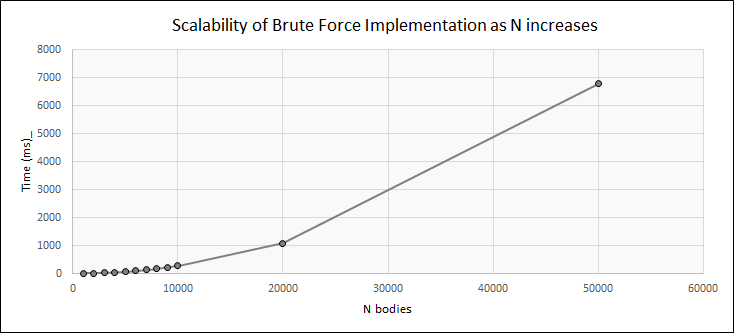
In Part 1 I built the naive brute-force N-body simulation and watched it fall apart past a few thousand bodies - almost 7 seconds per frame at 50,000 bodies. This time we're going to squeeze every last cycle out of that algorithm without changing the physics.
Spoiler: at N=20,000 the simulation goes from 477 seconds per frame to 1.2 seconds - roughly a 400x speedup.
Profiling First
Guessing where the bottleneck is rarely works. I built a custom in-simulation profiler that exports per-step force time, render time, and FPS to CSV, and ran the Visual Studio Performance Analyzer to see exactly where the CPU was burning cycles.
The culprit was obvious: the square root in the force calculation. A square root costs about 29 clock cycles versus 1 for an addition. At N=20,000 that's 400 million force calculations and 400 million square roots per frame - 11.6 billion clock cycles just for sqrt.
Even accounting for the rest of the math, the absolute best single-core runtime was over 3 seconds per frame. Real-time simulation on one thread was physically impossible, so the plan became: optimize single-core performance first, then throw threads at it, then use SIMD.
Compiler Optimizations
The first optimizations were embarrassingly cheap - no algorithm changes, just telling the compiler what it was allowed to do:
- Inlining via LTCG (Link-Time Code Generation): eliminates 400 million function-call jump-and-return cycles by laying
computeAccelerationinline with the loop. - O2: aggressive loop vectorization, code restructuring, and inline expansion.
- FastMath: treats division as multiplication by the reciprocal, and lets the compiler reorder floating-point operations.
These alone took N=20,000 from 477.85s to 51.04s - a 9.4x speedup.
Multithreading with OpenMP
The force loop has a beautiful property: each particle's acceleration depends only on the others, so the outer loop is embarrassingly parallel. One #pragma omp parallel for and the work splits across all 16 logical threads of the AMD 5800H.
| Bodies | Optimized (s) | Parallel (s) | Compiler speedup | Parallel speedup | Total |
|---|---|---|---|---|---|
| 1,000 | 0.22 | 0.30 | 4.7x | 0.7x | 3.4x |
| 5,000 | 3.36 | 1.00 | 7.6x | 3.4x | 25.7x |
| 20,000 | 51.04 | 7.41 | 9.4x | 6.9x | 64.5x |
| 100,000 | 1303.52 | 144.89 | - | 9.0x | - |
Note the 9x instead of the theoretical 16x - the 5800H has 8 physical cores with SMT, so 8x is the realistic ceiling. And for small N the thread-management overhead eats the gains.
SIMD with AVX2
Now the fun part. AVX2 registers are 256 bits wide - four doubles or eight floats at once. I restructured the algorithm to compute the attractions between two target particles (I) and four source particles (J) simultaneously, packing them into __m256 registers and driving the whole force kernel with AVX2 intrinsics.
A few tricks made the SIMD kernel fast:
- Mixed precision: positions load as doubles (preserving memory bandwidth), but get converted to floats for the arithmetic, so 8 interactions compute per instruction instead of 4.
- Hardware reciprocal square root (
_mm256_rsqrt_ps): replaces the 29-cyclesqrt+ division with a single fast intrinsic. - ID masking to zero out self-interactions instead of branching.
The result at N=20,000: 1.21s per frame, a 6.1x gain over the parallel version and roughly 395x faster than the baseline.
| Bodies | SIMD time (s) | Speedup vs parallel |
|---|---|---|
| 2,000 | 0.118 | 3.9x |
| 10,000 | 0.408 | 6.0x |
| 20,000 | 1.210 | 6.1x |
| 100,000 | 25.44 | 5.7x |
10 steps of N=100,000 ran in 25 seconds, down from 149 seconds for the parallel-only build.
What's Next
A 400x speedup sounds great until you realize the brute-force algorithm still scales O(N²). My next project ditches the double loop entirely for a Barnes-Hut tree with spatial partitioning, parallel tree construction, and Morton ordering - check it out. The full write-up for this project is available as a PDF report.